Why Human Transcription Is More Accurate Than AI (Detailed Comparison)
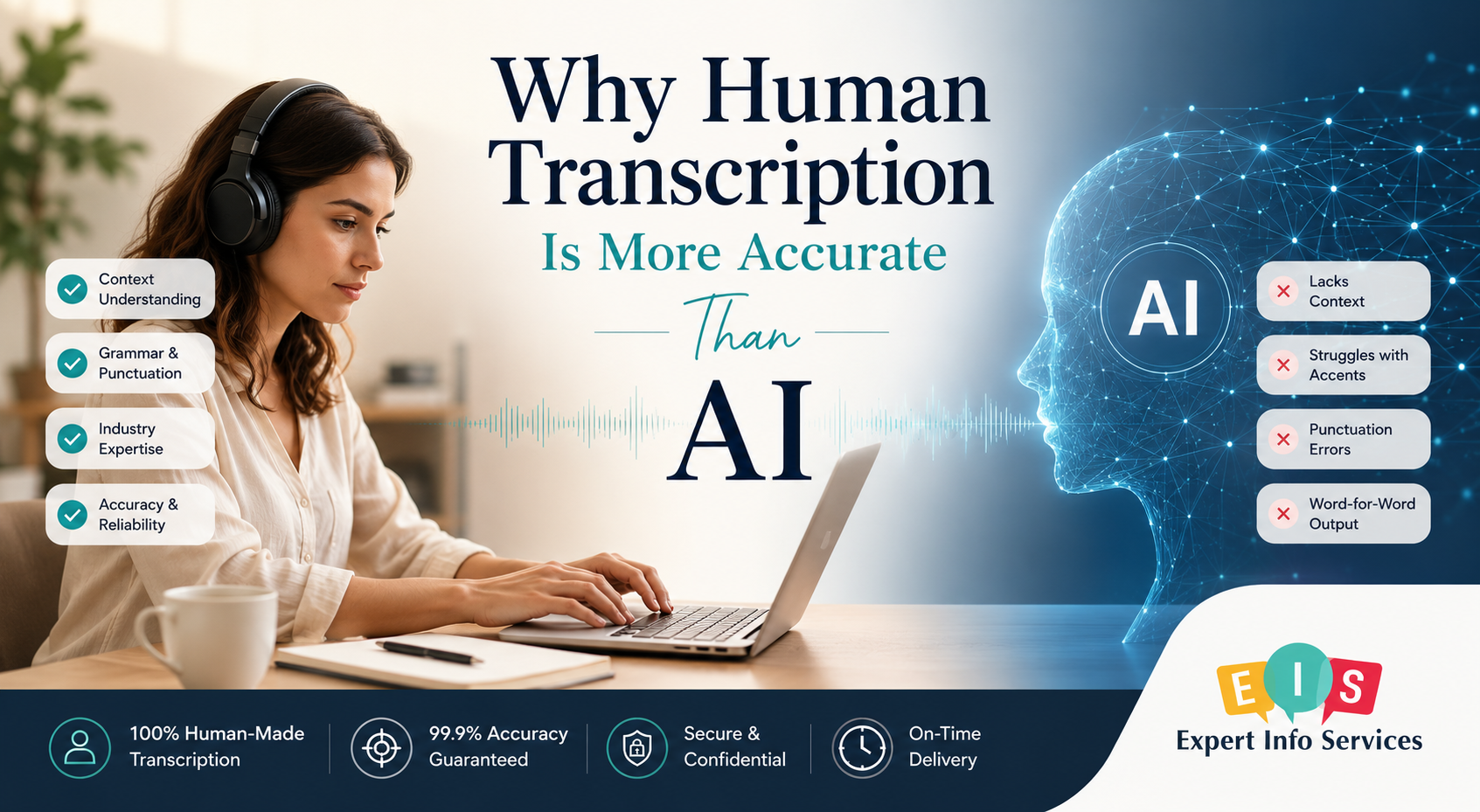
Blog Summary
AI transcription tools promise speed and low cost — but accuracy studies show 70–85% error rates on real-world audio. This guide explains exactly why human transcription delivers 99%+ accuracy, where AI falls short, and when each approach is the right call.
Human transcription is more accurate than AI — consistently reaching 99%+ accuracy — because humans understand context, nuance, specialized jargon, and diverse accents. AI tools struggle with poor audio, overlapping speech, and homophones, and typically deliver 70–85% accuracy on real-world recordings.
This is the complete breakdown: why it happens, where it matters most, and when each approach is actually the right call.
The Core Accuracy Gap
Every major AI transcription vendor publishes a headline accuracy rate. Most claim 90% or higher. What they don't tell you is that those numbers come from clean, studio-quality audio — a single native English speaker, no background noise, standard vocabulary.
Real-world audio is nothing like that.
Independent testing on actual client recordings consistently finds AI word error rates of 15–30% on telephone and Zoom audio, rising to 35–50% on noisy environments. Human transcriptionists trained in a subject area routinely achieve 99%+ on the same files.
That gap isn't a minor product difference. On a 60-minute legal deposition, a 15% error rate means roughly 900 missed or wrong words in a 6,000-word transcript.
6 Reasons Human Transcription Beats AI
1. Context and Nuance
AI transcription recognizes sounds and matches them to probable words. It does not understand meaning.
Humans do. A trained transcriptionist listening to a legal deposition understands that "He wasn't present" and "He was present" are opposites — and listens carefully for the negation. They understand that "the motion was denied" means something specific in a courtroom context. They catch sarcasm, irony, emphasis, and implied meaning that a statistical model completely misses.
This is the most fundamental difference: AI transcribes sounds. Humans transcribe meaning.
2. Handling Poor Audio
Background noise, telephone quality, Zoom compression, outdoor recordings, conference room echo — AI accuracy collapses in these conditions.
Human transcriptionists use noise-canceling headphones, slow playback, and relisten to difficult passages. They work around audio problems rather than failing on them. Professionals at Expert Info Services regularly deliver 99%+ accuracy on audio that AI tools return as 60–70% — or refuse to process at all.
3. Specialized Terminology
In medicine, law, and finance, vocabulary is everything — and AI consistently gets it wrong.
"Voir dire" becomes "whar dear." Drug names become misspelled or replaced with common words. Financial instruments, anatomical terms, Latin legal phrases, and diagnostic codes are routinely garbled by AI tools trained on general web text.
A human transcriptionist specializing in legal or medical work knows this vocabulary cold. They research unfamiliar terms before delivering the transcript. They never guess.
4. Speaker Differentiation
Identifying who is speaking — and switching accurately when speakers change — is called diarization, and it's one of AI's weakest capabilities.
When two speakers have similar voices, when they talk at the same time, or when there are more than three participants in a conversation, AI tools frequently misattribute speech or lose track entirely.
Human transcribers identify speakers by listening to sentence structure, vocabulary, pacing, and conversational logic. In legal depositions with multiple attorneys, witnesses, and a judge, accurate speaker attribution is not optional — it is the record.
5. Accents and Dialects
AI transcription models are trained predominantly on Standard American English. Speakers with regional American accents, British accents, Indian accents, Australian accents, or any non-standard speech pattern see significantly higher error rates — in some studies, up to 3x higher for certain dialects versus standard speech.
Humans adapt. A professional transcriptionist listens to a speaker's accent, adjusts their ear, and produces accurate output regardless of where the speaker is from. This is not something that can be replicated by a model trained on a fixed dataset.
6. Verbatim Accuracy
When required, human transcriptionists capture everything: every stutter, every false start, every "uh" and "um," every non-verbal cue like laughter or crying, every overlapping interruption with precise attribution.
Full verbatim transcription is required in legal proceedings, psychological research, linguistic studies, and documentary filmmaking. No AI tool delivers reliable full verbatim output — the models are specifically trained to clean up and normalize speech, which is the opposite of what verbatim requires.
When to Choose Human vs. AI
This is an honest comparison — not a sales pitch.
Choose human transcription when:
- Accuracy must be 99%+ (legal filings, medical records, academic research)
- Audio is poor quality, multi-speaker, or contains heavy accents
- Subject matter includes specialized terminology (medical, legal, financial)
- Confidentiality is legally required (HIPAA, attorney-client privilege, NDA)
- The transcript is going into an official record, published paper, or compliance document
- Speaker attribution must be exact
AI transcription is acceptable when:
- You need a rough draft for your own internal use
- The audio is clean, single-speaker, and conversational
- 90–95% accuracy is good enough and someone will review the output
- Cost is the primary constraint and errors have no consequence
- Volume is extremely high and speed outweighs precision
Many organizations use a hybrid approach: AI generates a first-pass draft, and a human transcriptionist reviews and corrects it for final delivery. This works well for high-volume projects where the audio is reasonably clean. At Expert Info Services, our workflow always ends with human review — we never deliver an AI-only output.
The Confidentiality Problem
One comparison that rarely gets made: what happens to your audio after you upload it.
Most consumer AI transcription platforms — including several major ones — use uploaded audio to train and improve their models. Read the fine print on their terms of service. That means your HIPAA-protected patient recording, your attorney-client privileged deposition, or your confidential business meeting may be ingested into a vendor's AI training pipeline.
Professional human transcription services operate differently. At Expert Info Services:
- We sign an NDA before work begins on every project
- Files are transmitted via encrypted channels only
- All files are permanently deleted after delivery
- No data is shared, retained, or used for any model training
For law firms, healthcare providers, and corporate clients, this isn't a preference — it's a legal requirement.
The Real Cost Comparison
The price difference between AI and human transcription is smaller than most people assume.
| | AI Transcription | Human Transcription (EIS) | |---|---|---| | Cost per minute | ~$0.25–$0.80 | From $0.84 | | Accuracy on real audio | 70–85% | 99%+ | | Speaker attribution | Unreliable | Accurate | | Confidentiality | Varies by vendor | NDA-protected, always | | Review before delivery | None | Human QA included | | Error correction cost | Your time | Covered by guarantee |
The price gap is often under $0.50 per minute. But one AI error in a legal filing that requires attorney correction costs hundreds of dollars in staff time. One misheard drug name in a medical record is a patient safety incident.
The economics of accuracy-critical transcription almost always favor human transcription.
How Expert Info Services Delivers 99%+ Accuracy
Every project at EIS follows the same process:
- Secure intake — encrypted upload, NDA signed before work begins
- Specialist matching — assigned to a transcriptionist trained in your subject matter
- First-pass transcription — complete listen-and-type by a specialist
- Human QA review — a second trained transcriptionist reviews the full transcript against the audio
- Delivery — in your format of choice: Word, PDF, SRT, VTT, or custom
Standard turnaround: 1–3 business days. Rush available in 4 hours.
Our 99% accuracy guarantee applies to your actual files — not a benchmark dataset. If we miss it, we fix it at no charge.
From Our Experience
From Our Experience at Expert Info Services
Over the years, our team has transcribed audio from law firms, hospitals, universities, and documentary producers across all 50 states. The most common audio we receive is far from clean — Zoom depositions with connection drops, clinical dictations recorded on phones in busy hallways, academic field interviews recorded outdoors.
The files that AI tools struggle with most are the ones we handle every day.
One pattern we see consistently: clients come to us after trying an AI tool first. They upload the same audio, receive a transcript with 99%+ accuracy, and ask why the price difference was less than $1 per minute.
Bottom Line
AI transcription is fast, inexpensive, and accurate enough for low-stakes use. The moment accuracy actually matters — legally, medically, professionally — it fails in ways that are predictable and costly.
Human transcription costs almost the same and delivers results no AI tool can match.
Request a free quote from Expert Info Services — or explore our services: Legal Transcription | Medical Transcription | All Services.
Also read: Will AI Replace Transcriptionists? The Honest Answer in 2026
We serve clients nationwide: Transcription Services in New Jersey · Transcription Services in California
About the Author
Rohan Akash
Digital Marketing Specialist & SEO Content Strategist
Rohan is a digital marketing specialist with a focus on SEO content strategy and industry research. He writes in-depth guides on transcription, language services, and AI technology to help businesses make informed decisions. His work has been published across multiple industry platforms, covering topics from speech-to-text accuracy to HIPAA compliance in healthcare transcription.
Need 99%+ Accurate Transcription?
Every transcript handled by a real human expert. HIPAA compliant, NDA protected, delivered in as fast as 4 hours.
Get a Free Quote