Will AI Replace Transcriptionists? The Honest Answer in 2026
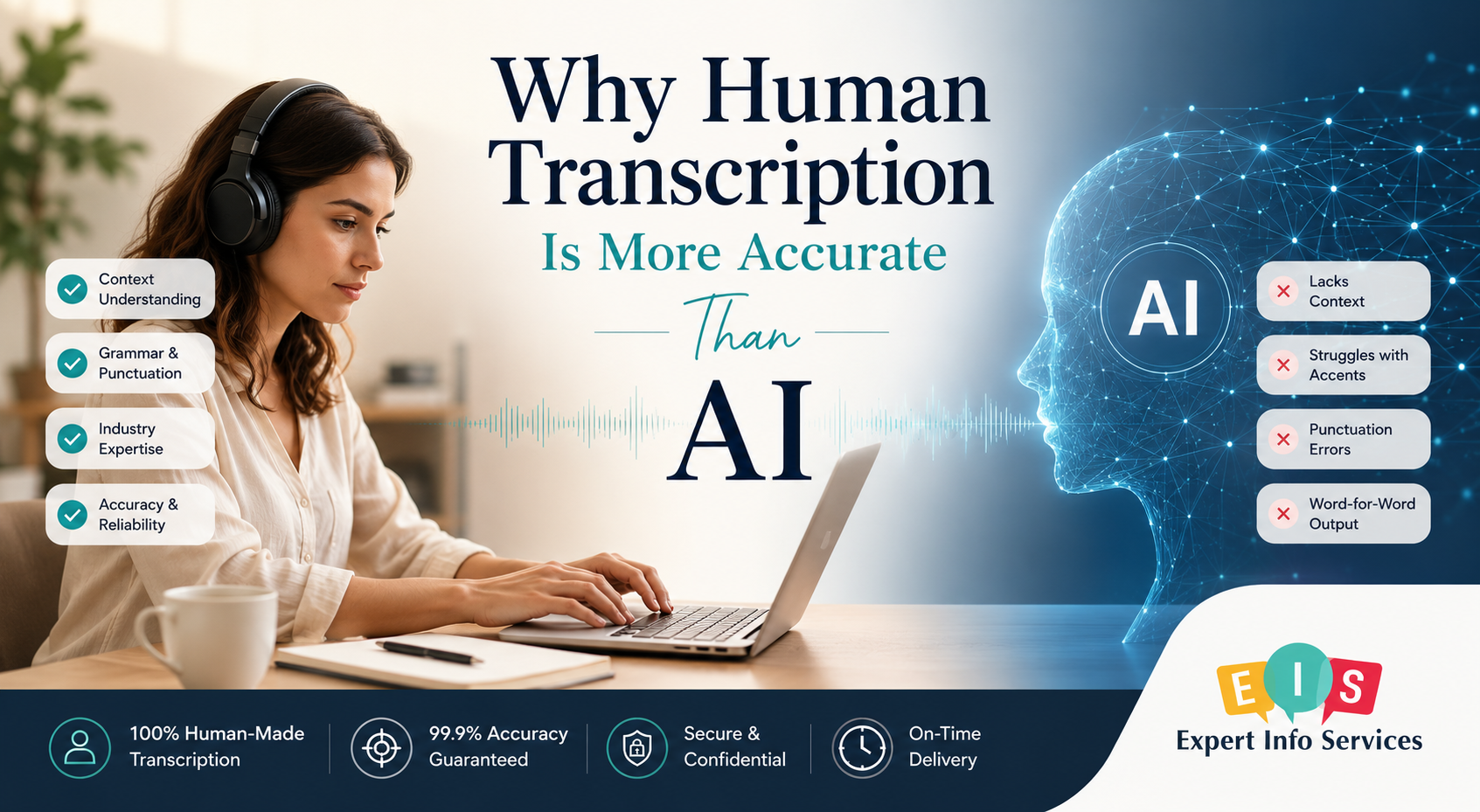
Blog Summary
AI transcription tools have transformed the industry — but they have not replaced human transcriptionists. This guide explains why skilled human transcribers remain essential in 2026, which industries cannot operate without them, and how the role is evolving rather than disappearing.
The short answer: No — AI will not fully replace human transcriptionists. Not in 2026, not in the next decade, and possibly never in industries where accuracy and accountability are legal requirements.
The longer answer is more interesting. AI has absolutely changed transcription. It has made basic audio-to-text conversion faster and cheaper. It has created entirely new workflows. And it has eliminated a large portion of low-skill transcription work that required no specialized knowledge.
But for the transcription work that actually matters — legal records, medical charts, academic research, broadcast media, corporate compliance — human transcriptionists are not just preferred. They are required.
Here is the full picture.
What AI Transcription Can Actually Do in 2026
Before explaining why AI cannot replace human transcriptionists, it is worth being honest about what AI does well.
Modern AI transcription tools — Otter.ai, Whisper, Rev AI, Google Speech-to-Text, Microsoft Azure — are genuinely impressive under the right conditions.
AI transcription is excellent for:
- Single-speaker audio in quiet environments
- Internal meeting notes where rough accuracy is acceptable
- First-draft transcription that a human will review and correct
- High-volume, low-stakes content like voice memos and casual interviews
- Quick turnaround when speed matters more than precision
Under ideal conditions — clean audio, standard American English, one speaker — leading AI tools achieve 90–95% accuracy. That sounds high. On a 60-minute file with 6,000 words, a 5% error rate means 300 wrong words. Whether that is acceptable depends entirely on what you are doing with the transcript.
7 Reasons AI Cannot Replace Human Transcriptionists
1. Legal Transcription Has Accuracy Requirements AI Cannot Meet
In legal proceedings — depositions, hearings, arbitrations, court transcripts — accuracy is not a preference. It is a legal requirement. A single missed word can change the meaning of sworn testimony. A misattributed statement can alter the outcome of a case.
Courts across the United States require certified transcriptionists for official legal records. AI-generated transcripts are not accepted as certified court records in most jurisdictions. No software certification can substitute for a trained, accountable human transcriptionist.
This alone ensures human transcription survives in the legal industry indefinitely.
2. Medical Transcription Is Governed by HIPAA — Not Just Accuracy
Medical transcription involves Protected Health Information (PHI). Every consumer AI transcription platform that processes your audio file — Otter.ai, Notta.ai, Descript, Happyscribe — has terms of service that may allow them to use your uploaded audio to train their models.
That is a direct HIPAA violation if the audio contains patient information.
Human transcription services that are HIPAA-compliant sign Business Associate Agreements, handle PHI under strict protocols, and permanently delete files after delivery. No AI tool offers equivalent accountability.
Healthcare providers — hospitals, clinics, private practices — cannot legally outsource transcription to tools that lack proper HIPAA compliance infrastructure.
3. AI Accuracy Collapses on Real-World Audio
The 90–95% AI accuracy figure is a benchmark number measured on clean, studio-quality audio with a single standard American English speaker. Real-world audio is nothing like that.
On telephone and Zoom audio, AI word error rates climb to 15–30%. On audio with background noise, multiple speakers, or non-standard accents, error rates regularly reach 35–50%.
A 2024 empirical study by the CISPA Helmholtz Center for Information Security tested 11 transcription services — 5 human, 6 AI — on real interview recordings. Manual transcription services consistently outperformed every AI tool, including OpenAI Whisper.
Human transcriptionists work through difficult audio. They slow playback, relisten, research unfamiliar terms, and deliver accurate output regardless of recording quality. AI tools fail where human transcriptionists succeed every day.
4. Multiple Speakers Break AI Systems
Speaker diarization — identifying who is speaking and when — is one of the weakest capabilities of current AI transcription. When voices are similar, when speakers interrupt each other, or when a conversation has more than three participants, AI tools frequently misattribute speech or lose track of the conversation entirely.
In a legal deposition with a judge, two attorneys, and a witness, misattributed speech is not a formatting error. It is a defect in an official record.
Human transcribers identify speakers by context, sentence structure, vocabulary, and listening pattern — skills developed over years of practice that no model currently replicates reliably.
5. Specialized Industries Require Specialized Vocabulary
Consider this phrase from a legal deposition: "The plaintiff's counsel invoked the res ipsa loquitur doctrine during voir dire."
AI tools trained on general internet text regularly mishear and misspell legal Latin phrases, medical terminology, financial instruments, scientific nomenclature, and industry-specific acronyms. The errors are not random — they are predictably wrong in ways that can be catastrophic in professional documents.
A human transcriptionist specializing in legal or medical work knows this vocabulary. They verify unfamiliar terms before delivery. They never guess.
6. Verbatim Transcription Cannot Be Automated
Full verbatim transcription — capturing every stutter, false start, filler word, non-verbal cue (laughter, crying, sighing), and overlapping interruption with precise attribution — is required for psychological research, linguistic analysis, legal proceedings, and documentary filmmaking.
AI transcription models are specifically trained to clean up and normalize speech. They smooth out hesitations, drop filler words, and ignore paralinguistic cues. This is the opposite of what verbatim transcription requires.
For any use case requiring true verbatim output, human transcription is the only option.
7. Confidentiality Cannot Be Guaranteed by Software
When you upload an audio file to a consumer AI tool, read the fine print. Many platforms explicitly state that uploaded content may be used to improve their models. Your confidential business meeting, your privileged attorney-client call, your patient consultation — all potentially retained and processed.
Human transcription services operate under signed NDAs. At Expert Info Services, an NDA is signed before work begins on every single project. Files are encrypted in transit and permanently deleted upon delivery. No algorithm can make that commitment.
The Counterintuitive Truth: AI Is Creating More Demand for Transcription
Here is the angle most articles on this topic miss entirely.
AI has not reduced the total amount of transcription work. It has massively increased it.
The explosion of podcasts, video content, webinars, online courses, and recorded meetings has created far more audio and video content than the industry has ever processed before. AI handles the low-end volume — the internal meetings, the rough drafts, the quick voice notes.
But it has also introduced millions of people to the value of having audio converted to text. Many of those users eventually need a file that AI cannot handle accurately — a legal recording, a medical dictation, a multi-speaker focus group, an academic interview with a non-native speaker.
They come to human transcription services because AI failed them first.
This pattern is consistent across the industry. The transcription market was valued at approximately $26 billion in 2022 and is growing. AI has expanded the market by making transcription accessible to a wider audience while simultaneously demonstrating its own limitations on complex content.
How the Role of the Transcriptionist Is Evolving
The transcriptionist who spends hours manually typing simple, single-speaker audio is rarer today. AI handles that work cheaply and fast enough.
The transcriptionist in demand today is a specialist:
Legal transcription specialist — knows court procedure, case law terminology, deposition formatting requirements, and how to handle attorney-witness crosstalk.
Medical transcription specialist — knows anatomy, pharmacology, diagnostic codes, and HIPAA compliance requirements.
AI transcript editor — reviews and corrects AI-generated drafts, catching systematic errors that AI tools produce consistently on certain types of audio.
Multilingual transcription specialist — handles audio in languages where AI tools perform poorly, particularly non-European languages and regional dialects.
These roles pay more, require more skill, and are more resilient to automation than basic transcription ever was.
Industries Where Human Transcription Is Non-Negotiable
| Industry | Why AI Cannot Replace Humans | |---|---| | Legal | Certified transcripts required by courts, chain of custody requirements | | Medical / Healthcare | HIPAA compliance, PHI handling, clinical terminology accuracy | | Academic Research | Verbatim requirements, multi-speaker complexity, ethical data handling | | Broadcast / Documentary | Precision timing, speaker identification, editorial accuracy standards | | Financial / Insurance | Compliance requirements, complex terminology, liability for errors | | Law Enforcement | Evidence chain requirements, certified accuracy standards |
In every one of these industries, AI-generated transcription is either legally insufficient, practically unreliable, or both.
What the Next 5 Years Actually Look Like
The Bureau of Labor Statistics projects a modest decline in traditional transcription roles through 2032. That projection captures the elimination of low-skill transcription work — the basic, single-speaker, clean-audio files that AI now handles adequately.
It does not capture the growth in specialized transcription roles, the expansion of content requiring transcription, or the new category of AI transcript editing and quality assurance work.
The realistic picture for 2026–2031:
- Low-skill transcription volume declines (AI handles it)
- Specialist transcription demand grows (legal, medical, multilingual)
- AI transcript editing becomes a standard role
- Total transcription market continues expanding due to content volume growth
- Human transcription premium increases as the skill gap widens
AI will take the easy work. The difficult, high-stakes, accountability-required work will remain with trained human professionals.
Frequently Asked Questions
Will AI replace transcriptionists completely? No. AI will handle simple, low-stakes transcription — and already does. But legal, medical, academic, and broadcast transcription requires human skill, accountability, and specialized knowledge that current AI cannot replicate. These segments are growing, not shrinking.
Is AI transcription accurate enough for professional use? It depends on the use case. For internal notes and rough drafts — yes. For legal records, medical charts, or any compliance-sensitive document — no. AI word error rates on real-world audio typically reach 15–30%, which is unacceptable in professional contexts.
Are transcription jobs disappearing? Low-skill transcription jobs are declining. Specialist transcription roles — legal, medical, multilingual, AI-editing — are in demand. The overall transcription market is growing due to the explosion of audio and video content creation.
Can AI transcription be used as a first draft? Yes, and this hybrid approach is increasingly common. AI generates a rough transcript; a human transcriptionist reviews, corrects, and formats it for delivery. This works best when source audio is reasonably clean and no specialized terminology is involved.
Which industries will always need human transcriptionists? Legal, medical, academic research, broadcast media, law enforcement, and financial compliance. These industries have accuracy, confidentiality, and accountability requirements that AI tools cannot satisfy under current technology or regulatory frameworks.
How do I know if I need human or AI transcription? Ask two questions: Does the transcript need to be 99%+ accurate? Does confidentiality matter legally? If yes to either — use a human transcription service. If your audio is clean, your content is informal, and errors have no consequence — AI is fine.
Get a free human transcription quote from Expert Info Services — or read our full comparison: Why Human Transcription Is More Accurate Than AI.
Our Services: Legal Transcription | Medical Transcription | Business Transcription | All Services
We serve clients nationwide: Transcription Services in New Jersey · Transcription Services in California
About the Author
Rohan Akash
Digital Marketing Specialist & SEO Content Strategist
Rohan is a digital marketing specialist with a focus on SEO content strategy and industry research. He writes in-depth guides on transcription, language services, and AI technology to help businesses make informed decisions. His work has been published across multiple industry platforms, covering topics from speech-to-text accuracy to HIPAA compliance in healthcare transcription.
Need 99%+ Accurate Transcription?
Every transcript handled by a real human expert. HIPAA compliant, NDA protected, delivered in as fast as 4 hours.
Get a Free Quote